
What Makes Your Heat Pump Different from a Simple Air Conditioner
A heat pump reversing valve is the critical component that allows your heat pump to switch between heating and cooling modes by reversing the direction of refrigerant flow through the system.
Quick Answer: What is a Heat Pump Reversing Valve?
- What it is: A 4-way valve (also called a changeover valve) located in your heat pump’s outdoor unit
- Primary function: Reverses refrigerant flow to switch between heating and cooling modes
- How it works: Controlled by a solenoid coil that receives a 24-volt AC signal from your thermostat
- Two states: Relaxed (unactivated) for one mode, energized for the other mode
- Key difference: This single component is what makes a heat pump different from a standard air conditioner
If you’ve ever wondered how one system can both heat and cool your home, the answer is the reversing valve. Without this component, your heat pump would be nothing more than a regular air conditioner—able to cool but not heat.
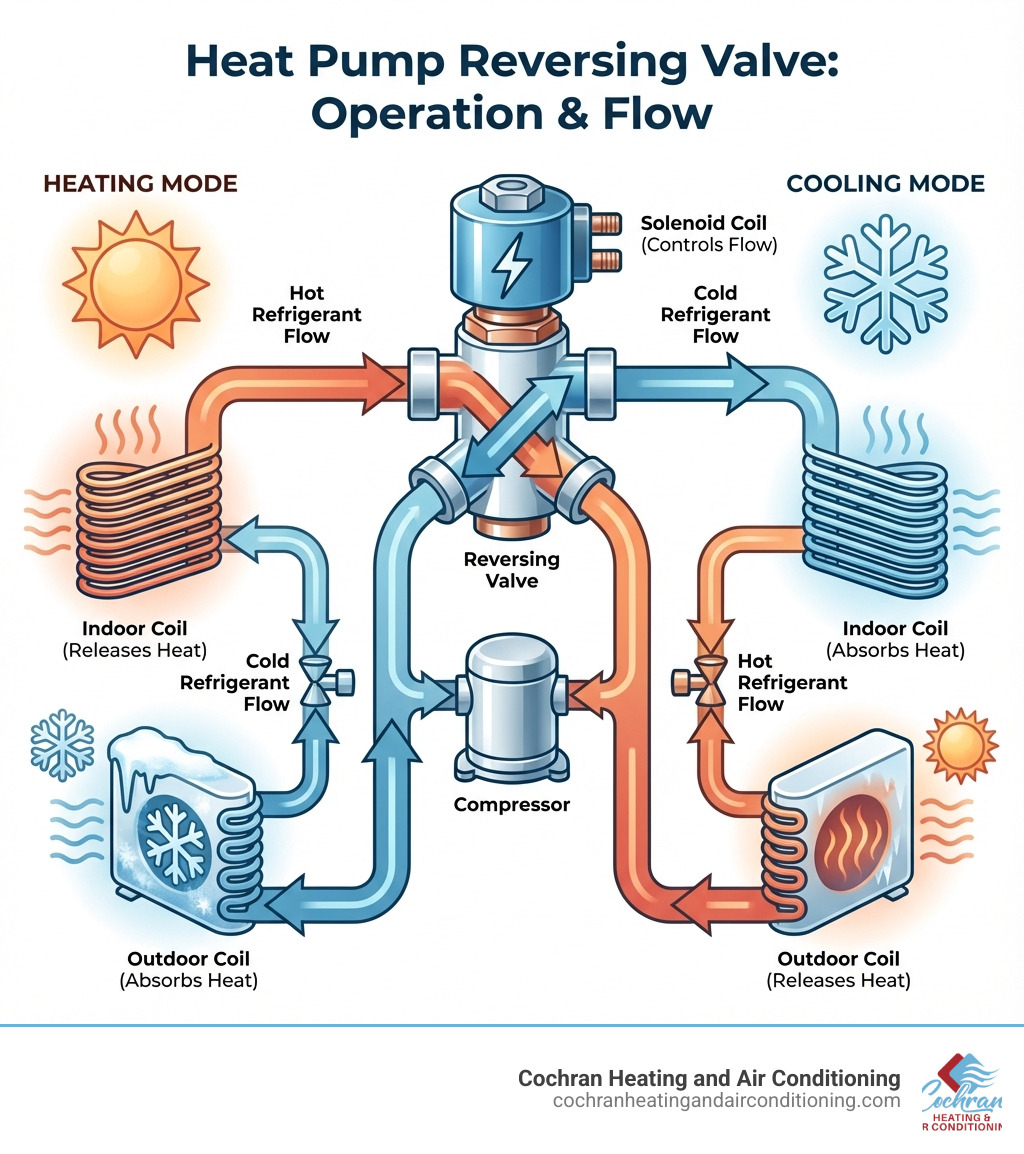
The reversing valve sits near the compressor in your outdoor unit and connects to four refrigerant lines. When your thermostat calls for heating, the valve redirects hot refrigerant to your indoor coil. When you need cooling, it sends that hot refrigerant outside instead. This neat solution means you get year-round comfort from a single piece of equipment.
Understanding how this valve works can help you recognize problems early and avoid costly repairs. More importantly, it helps you appreciate why professional maintenance matters so much for heat pump systems.
How a Heat Pump Reversing Valve Works
Imagine your heat pump as a magician, effortlessly making heat appear inside your home in winter and disappear in summer. The heat pump reversing valve is the wand that makes this magic happen! It’s the central component that determines the direction of refrigerant flow, thus dictating whether your system is providing heating or cooling.
Unlike a standard air conditioner, which only moves heat out of your home, a heat pump is designed to move heat in either direction. This is achieved by manipulating the refrigeration cycle—a continuous process of absorbing, compressing, condensing, and expanding refrigerant. The reversing valve acts as a traffic cop for this refrigerant, redirecting its flow to change the roles of your indoor and outdoor coils.
Because it connects four pipes—one from the compressor, one back to the compressor, and two to the indoor and outdoor coils—it’s often referred to as a “4-way valve.” This design is essential for its ability to completely reverse the heat transfer process. To learn more about how your entire heat pump system works to keep you comfortable, check out our Heat Pump services.

Switching Between Heating, Cooling, and Defrost Modes
The ingenious design of the heat pump reversing valve allows your system to perform three crucial functions: heating, cooling, and even defrosting. Let’s explore how it orchestrates these mode changes:
Heating Mode
When your thermostat calls for heat, the reversing valve is activated (or deactivated, depending on the manufacturer’s design). In heating mode, the valve directs the hot, high-pressure refrigerant vapor from the compressor to your indoor coil. Here, the refrigerant condenses, releasing its absorbed heat into your home’s air, which is then circulated through your ducts. Simultaneously, the outdoor coil now acts as the evaporator, absorbing heat from the outside air, even on chilly days. Believe it or not, even air at 32°F contains enough heat energy to warm your home!
Cooling Mode
When summer arrives and you switch your thermostat to cooling, the reversing valve changes its state. It now directs the hot, high-pressure refrigerant from the compressor to the outdoor coil. The outdoor coil becomes the condenser, releasing the heat absorbed from your home into the outside air. The indoor coil, in turn, functions as the evaporator, absorbing heat and humidity from your indoor air, providing that refreshing cool breeze.
Defrost Cycle
In colder temperatures, as the outdoor coil absorbs heat from the cold air, moisture in the air can freeze on its surface, leading to ice buildup. This ice can obstruct airflow and reduce efficiency. This is where the heat pump reversing valve plays another vital role. When your heat pump detects significant ice accumulation, it temporarily switches into a defrost cycle. During this cycle, the reversing valve shifts the system into cooling mode, directing hot refrigerant to the outdoor coil to melt the ice. To prevent your home from getting chilly during this brief process, auxiliary electric heat strips (often called “heat strips”) are activated to maintain your indoor temperature. Once the ice is melted, the valve reverts to normal heating operation.
Thermostat Settings and Control Wiring
The entire dance of the reversing valve is initiated by your thermostat. Most heat pumps use a 24-volt AC electrical signal to control the valve. The thermostat typically has an ‘O’ terminal (for cooling mode activation) or a ‘B’ terminal (for heating mode activation), which sends this signal to the reversing valve’s solenoid.
The heat pump reversing valve has two primary states: “relaxed” (unactivated) and “energized” (activated by the 24-volt AC signal). What happens in each state depends on the manufacturer. For some, the relaxed state defaults to heating, and energizing the valve switches it to cooling. For others, the relaxed state defaults to cooling, and energizing it switches to heating. For example, some manufacturers like Ruud and Rheem may use a ‘B’ terminal or blue wire to energize their systems’ reversing valves in heating mode, while the common orange wire typically energizes for cooling. This energized state is typically achieved by applying 24 volts AC, which is common in HVAC equipment.
Key Components and Their Interaction
While the heat pump reversing valve might seem like a simple switch, its internal mechanism is a marvel of engineering. It’s composed of several key parts that work in concert to redirect refrigerant flow:
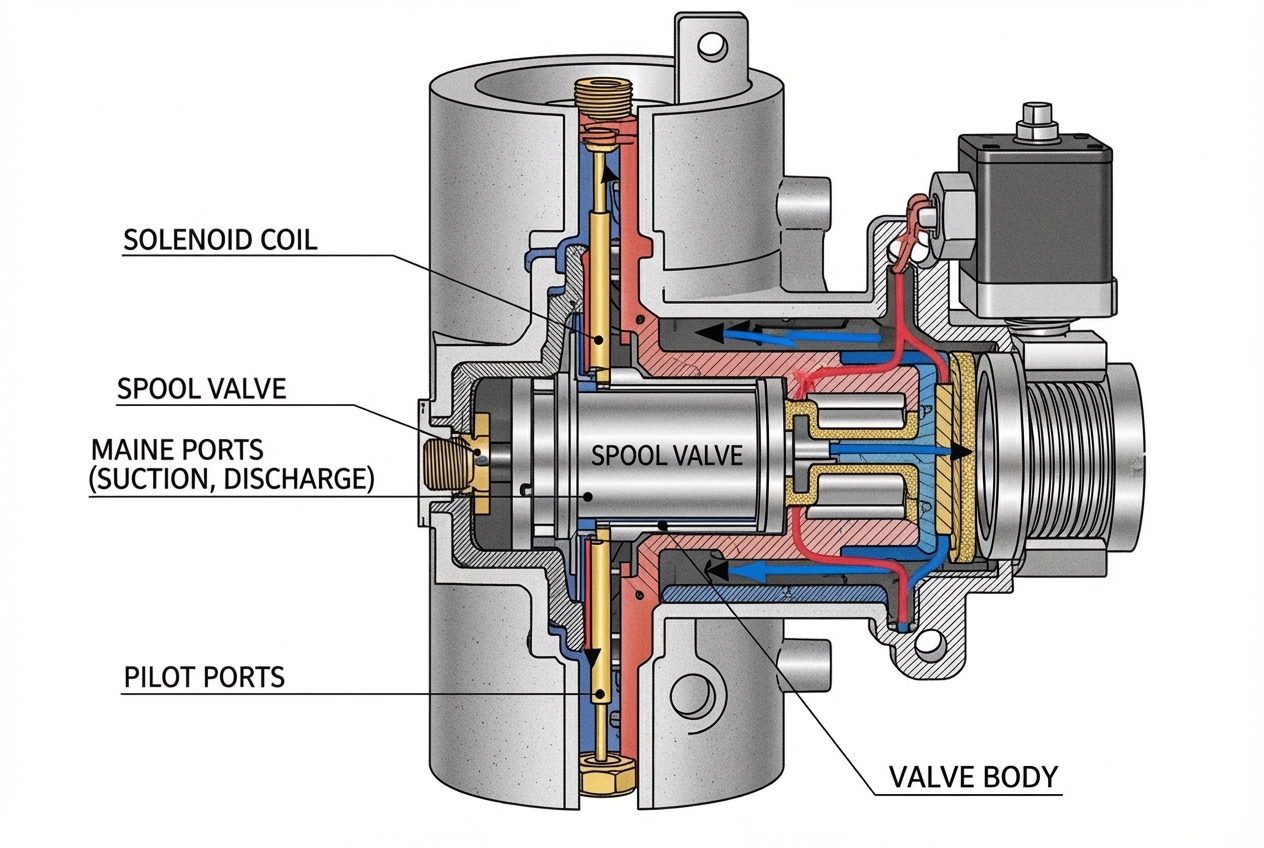
At its core, the reversing valve consists of a main slide valve, a pilot valve, and a solenoid coil.
-
Solenoid Coil: This is the electrical component. When the thermostat sends a 24-volt AC signal, the solenoid coil becomes energized, creating a magnetic field. We’ve found that the resistance of the reversing valve solenoid coil is generally between 0.5-2KΩ. Any significant deviation from this range could indicate a problem.
-
Pilot Valve: The energized solenoid acts on a small plunger, which in turn moves the pilot valve. This tiny valve’s job is to redirect a small amount of high-pressure refrigerant to one end of the main slide valve.
-
Main Slide Valve (or “Canoe”): This is the largest moving part within the valve, often colloquially referred to as a “canoe” due to its shape. The pilot valve’s action creates a pressure differential across the ends of this main slide. This pressure imbalance forces the slide to move rapidly from one side to the other.
How They Interact
When the solenoid coil energizes, it shifts the pilot valve. This shift directs high-pressure refrigerant to one side of the main slide valve, while simultaneously venting the pressure from the other side. The resulting pressure differential pushes the main slide to its new position. This physical movement of the slide changes the internal connections within the valve, effectively reversing the paths of the refrigerant lines. This entire process happens almost instantly, allowing your heat pump to transition smoothly between heating and cooling modes.
Without this intricate interaction, your heat pump simply wouldn’t be able to achieve its dual functionality. It’s a testament to clever design that such a critical function is performed by relatively few moving parts. For a deeper dive into the specific components and their roles, you might find this external resource helpful: What is a Reversing Valve.
Troubleshooting a Malfunctioning Heat Pump Reversing Valve
A properly functioning heat pump reversing valve operates silently and efficiently in the background, ensuring your home stays comfortable year-round. However, like any mechanical component, it can sometimes malfunction. When it does, the consequences can range from minor inefficiencies to complete system failure, leaving you either too hot or too cold. Diagnosing a reversing valve issue can be tricky because its symptoms often mimic other heat pump problems. That’s why professional expertise is invaluable. For more information on general HVAC repairs, visit our page on HVAC Repair & Maintenance.
Common Signs and Symptoms of Failure
Recognizing the early warning signs of a failing heat pump reversing valve can save you from more extensive damage and discomfort. Here are the most common symptoms we encounter:
- Stuck in One Mode (Heating or Cooling): This is perhaps the most obvious sign. If your heat pump is blowing cold air when you’ve set it to heat, or hot air when you expect cooling, the reversing valve might be stuck. It simply isn’t able to redirect the refrigerant flow.
- Lukewarm Air from Vents: If your system is running but the air coming out of the vents isn’t quite hot or cold enough, it could indicate a partial failure or an internal leak within the reversing valve. The refrigerant isn’t being fully directed to its intended coil, leading to inefficient heat transfer.
- Strange Noises (Clicking, Hissing, Buzzing): While some operational noises are normal, persistent clicking, hissing, or buzzing sounds coming from the outdoor unit—especially during mode changes—can point to a struggling or faulty reversing valve solenoid. A healthy solenoid should typically make a distinct “click” when activated.
- High Energy Bills: When the reversing valve isn’t working correctly, your heat pump has to work much harder and longer to achieve the desired temperature. This increased effort translates directly into significantly higher electricity bills, even if your home never quite reaches optimal comfort.
- System Short Cycling: If your heat pump turns on and off frequently without completing a full heating or cooling cycle, it could be a symptom of a reversing valve issue. The system might be struggling to maintain set points due to inefficient operation caused by the valve.
Potential Causes and Consequences
Understanding why a heat pump reversing valve fails is crucial for effective diagnosis and repair. The causes can generally be categorized into electrical or mechanical issues, with significant consequences if left unaddressed.
Electrical Issues
The most common electrical problem involves the solenoid coil.
- Solenoid Failure: The 24-volt AC signal from the thermostat might not be reaching the solenoid, or the solenoid coil itself could be faulty. A coil can burn out (open circuit), short out, or simply weaken over time. If the solenoid isn’t receiving power or can’t generate a strong enough magnetic field, the pilot valve won’t move, and thus the main slide won’t shift. We often check the resistance of the solenoid coil; if it’s outside the 0.5-2KΩ range, it’s a strong indicator of failure.
Mechanical Issues
These problems directly affect the physical movement of the internal components.
- Stuck Slide: The main slide valve can become physically stuck. This can be due to impurities in the refrigerant system (like debris or sludge) that jam the slide, or even external deformation of the valve body (e.g., from physical impact or overheating). If the slide cannot move, the refrigerant flow cannot be reversed. Sometimes, a technician might gently tap the valve body with a plastic tool to try and free a stuck slide, but this is a temporary fix.
- Insufficient Pressure Differential: The reversing valve relies on a pressure differential created by the pilot valve to move the main slide. If the system has low refrigerant charge, or if the compressor is weak, there might not be enough pressure to shift the slide. This can also happen if the system has been off for a long time and the pressures haven’t equalized.
Internal Refrigerant Leaks
- Worn Seals: Over time, the internal seals within the reversing valve can wear out or become damaged. This allows a small amount of refrigerant to bypass the intended flow path, essentially “splitting” the refrigerant between the hot and cool sides. This leads to inefficient operation and lukewarm air. A tell-tale sign of an internal leak is a temperature difference greater than 3°F between the suction lines in either heating or cooling mode.
Consequences of Failure
Ignoring a faulty heat pump reversing valve can lead to severe and costly repercussions for your entire heat pump system:
- Reduced Efficiency: Your heat pump will struggle to maintain comfortable temperatures, leading to significantly higher energy bills as it works harder and longer.
- Potential Compressor Damage: The compressor is the heart of your heat pump. A malfunctioning reversing valve can cause the compressor to operate under abnormal stress, leading to overheating, premature wear, and ultimately, compressor failure. Replacing a compressor is one of the most expensive heat pump repairs.
How a Technician Diagnoses the Problem
Diagnosing a problem with a heat pump reversing valve requires a skilled HVAC technician with specialized tools and knowledge. While homeowners can look for symptoms, actual diagnosis involves a methodical approach:
- Visual Inspection: The technician will first visually inspect the outdoor unit and the reversing valve itself. They’ll look for any obvious signs of damage, disconnected wires, scorch marks on the solenoid coil (indicating overheating), or physical dents on the valve body.
- Listening for Solenoid Click: With the system powered on and commanded to change modes, the technician will listen closely to the reversing valve’s solenoid. A healthy solenoid should produce a clear, audible click or thud as it activates. A weak click, buzz, or no sound at all suggests an electrical or solenoid issue.
- Voltmeter Test on Solenoid: To confirm electrical integrity, a technician will use a multimeter to check if the 24-volt AC control voltage is reaching the solenoid coil. If the voltage is present but the solenoid isn’t activating, the coil itself is likely faulty. They may also check the coil’s resistance.
- Temperature Checks on Copper Lines: Using a thermometer, the technician will measure the temperature of the various copper lines connected to the reversing valve, especially the suction lines. Significant temperature differences (e.g., more than 3°F) between specific lines can indicate an internal refrigerant leak within the valve, meaning refrigerant is bypassing the intended path.
- Refrigerant Pressure Gauge Readings: Attaching pressure gauges to the system allows the technician to assess the refrigerant charge and the pressures in different parts of the system. This helps confirm if there’s sufficient pressure differential for the valve to operate or if low refrigerant is contributing to the problem. It also helps rule out other refrigeration cycle issues.
By combining these diagnostic steps, our technicians can accurately pinpoint whether the heat pump reversing valve is the culprit or if another component is causing your heat pump’s woes.
Reversing Valve Replacement and Maintenance
When a heat pump reversing valve fails, it’s not a repair job for the average DIY enthusiast. This is a complex procedure that involves handling refrigerants, which are regulated substances, and working with brazing equipment and high-pressure systems. Attempting this repair yourself can be dangerous, illegal (due to refrigerant release), and can cause further damage to your expensive heat pump. Always trust a certified HVAC professional for this kind of work. If you’re noticing any of these issues, it’s time to consider professional help. See more about Signs Your Home HVAC System Needs Repair in Joplin, MO.
The Process and Cost of Replacing a Heat Pump Reversing Valve
Replacing a heat pump reversing valve is one of the more involved repairs for a heat pump system. Here’s a general overview of the process a qualified technician follows:
- Refrigerant Recovery: First and foremost, the technician will use specialized equipment to safely recover all the refrigerant from your heat pump system. This is crucial for environmental protection and to comply with regulations.
- De-brazing the Old Valve: The reversing valve is permanently connected to the refrigerant lines through brazed (welded) joints. The technician will carefully use a torch to heat and melt these joints, allowing them to remove the old, faulty valve. This requires precision to avoid damaging nearby components.
- Brazing the New Valve: The new reversing valve is then carefully positioned and brazed into place. During this step, the technician must take precautions to prevent overheating the new valve, which could damage its internal components. This often involves using wet rags or heat-absorbing paste.
- System Evacuation: Once the new valve is brazed in, the system is still open to the atmosphere and contains air and moisture. The technician will connect a vacuum pump to evacuate the system, pulling out all non-condensable gases and moisture. This step is critical for preventing future system failures.
- Refrigerant Recharging: Finally, the technician will recharge the system with the precise amount and type of refrigerant specified by the manufacturer. This is often done by weight to ensure optimal performance.
The typical cost associated with heat pump reversing valve replacement can vary. Based on industry statistics, the average cost to replace the reversing valve is between $400-$700. However, this cost can fluctuate based on factors like your specific heat pump model, the complexity of the installation, regional labor rates, and the cost of the replacement part itself.
Preventative Maintenance for Longevity
While a heat pump reversing valve is a robust component, regular preventative maintenance is key to ensuring its longevity and the overall efficiency of your heat pump system. Here are some tips we recommend:
- Regular HVAC Inspections: Schedule annual or bi-annual professional heat pump inspections (typically in the spring and fall). During these visits, a technician will check refrigerant levels, electrical connections, and the overall operation of your heat pump, including the reversing valve. Early detection of minor issues can prevent major failures.
- Changing Air Filters: This might seem unrelated, but a clogged air filter restricts airflow, forcing your heat pump to work harder. This added strain can indirectly affect all components, including the reversing valve, by causing the system to operate outside its optimal parameters. Change standard air filters every 30-90 days, or as recommended by your technician.
- Keeping Outdoor Unit Clear of Debris: Ensure the area around your outdoor unit is free from leaves, grass clippings, dirt, and other debris. Obstructions can impede proper airflow, reduce efficiency, and potentially lead to overheating or ice buildup issues that stress the system and its components.
- Promptly Addressing Performance Changes: Don’t ignore unusual noises, lukewarm air, or unexpected spikes in your energy bills. Early intervention can often resolve issues before they escalate into costly repairs, potentially saving your reversing valve from permanent damage.
By taking these preventative measures, you’re not just maintaining your heat pump reversing valve; you’re safeguarding your entire heat pump system, ensuring reliable, efficient heating and cooling for years to come.
Conclusion
The heat pump reversing valve is truly the unsung hero of your heat pump system. It’s the ingenious component that empowers your heat pump to deliver year-round comfort, seamlessly transitioning between heating and cooling your home. Without this small but mighty part, your heat pump wouldn’t be able to provide the energy-efficient, dual-functionality you rely on.
Understanding its function, recognizing the signs of a potential malfunction, and knowing the importance of professional diagnosis and repair are crucial for any homeowner with a heat pump. A faulty reversing valve can quickly lead to discomfort, soaring energy bills, and even severe damage to your compressor.
That’s why professional expertise is invaluable. Our team at Cochran Heating and Air Conditioning has the knowledge, tools, and experience to diagnose, repair, and maintain your heat pump’s reversing valve, ensuring your system operates at peak efficiency. Don’t let a small component disrupt your home’s comfort.
For reliable heat pump services in Joplin, including expert reversing valve diagnostics and replacement, don’t hesitate to reach out to us. We’re here to help you maintain a comfortable and energy-efficient home. Contact us for Heat Pump Services in Joplin today!